
Professor Pascale Chevalier, University Clermont Auvergne, France
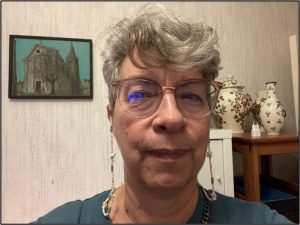 Pascale Chevalier is a Full Professor of Medieval Archaeology and Art History at the University Clermont Auvergne (France) and a member of the CHEC research centre (Centre d’Histoire “Espaces et Cultures”). She earned her PhD in 1991 from Sorbonne University in Paris, where her dissertation focused on approximately 300 Early Christian churches in the Roman Province of Dalmatia. Following her doctoral studies, she completed a two-year postdoctoral fellowship at the Archaeological Museum in Split (1992–1994).
In addition to publishing extensively on sculpture and building archaeology, Professor Chevalier has led numerous archaeological field schools for her students in France. Her primary research is conducted in Croatia and Albania, where she investigates religious architecture, the evolution of urban sites (such as Salona, Poreč, and Byllis), and the transformation of archaeological landscapes from the Late Antique to the Medieval period. She is a key member of the Monacorale project (2020–2026), a collaboration between French and Croatian archaeologists and historians focused on the earliest monastic landscapes (4th–12th centuries) along the eastern Adriatic coast and islands; she specifically oversees the research for the Istria region. Since 2023, she has also been part of a multidisciplinary team in the Puglia region of Italy, studying rural landscapes around Sava through the analysis, survey, and excavation of dry-stone architecture and boundaries.
Professor Anita Pavić Pintarić, University of Zadar, Croatia
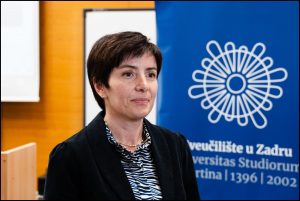 Anita Pavić Pintarić is a Full Professor of Philology, specialising in German Linguistics, within the Department of German Studies at the University of Zadar. Her research interests encompass emotionality in language, fictive orality, translation studies, phraseology, pragmalinguistics, and contrastive and contact linguistics. She has led one bilateral research project and contributed to nine scientific projects, seven of which were international in scope.
Professor Pavić Pintarić has authored over sixty scientific papers and two monographs: Deutsche und kroatische Idiome kontrastiv: Eine Analyse von Ausdruck und Funktion (2015) and the co-authored Prostor i kretanje u govorima zadarskoga kraja (2021). In addition to co-editing several volumes and co-organising numerous scientific conferences, she serves as the linguistics editor for Germanistica Euromediterrae, the official journal of her department. She is also a member of the scientific boards for the journal Linguistische Treffen in Wrocław and the series Studia Phraseologica et Paroemiologica (Dr Kovač Publishing, Hamburg).
Beyond her research, Professor Pavić Pintarić is actively involved in the EU-CONEXUS European University Alliance, where she serves as Chair of the Academic Council. She has been the academic head of the Austrian Library “Dr Alois Mock” since its opening in 2013. In October 2023, she was appointed Vice-Rector for Students and Study Affairs at the University of Zadar.
Prescilla Perrichon, PhD, Institute of Marine Research, Norway
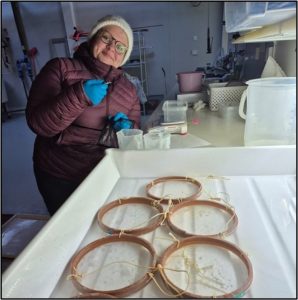 Prescilla Perrichon earned her PhD in Environmental Sciences and Ecotoxicology from the University of La Rochelle and the French Research Institute for Exploitation of the Sea (IFREMER) in 2014. She subsequently completed postdoctoral fellowships at the University of North Texas (USA) from 2015 to 2017 and at the Institute of Marine Research (Norway) from 2018 to 2021. Since 2022, she has served as a Researcher in the Reproduction and Developmental Biology group at the Institute of Marine Research’s Austevoll Research Station.
Over the past 12 years, Dr Perrichon’s research has spanned marine environmental toxicology, aquaculture, fish physiology, developmental biology, and cardiac electrophysiology. Her primary research goal is to understand the ontogenesis and functional integrity of key physiological processes in marine organisms—specifically fish—encompassing development, behaviour, and cardiovascular function. Her work investigates diverse biological levels, ranging from molecular pathways to individual responses. A central focus of her research is how environmental variables, including climate change, influence the toxicity of co-occurring contaminants (such as organic compounds and crude oil) in aquatic ecosystems. Additionally, she is actively involved in international collaborations focused on ocean management and sustainable social and economic development.