International Conference
Funerary Epigraphy and Practices
21st November 2026, beginning at 9 AM
University of Zadar
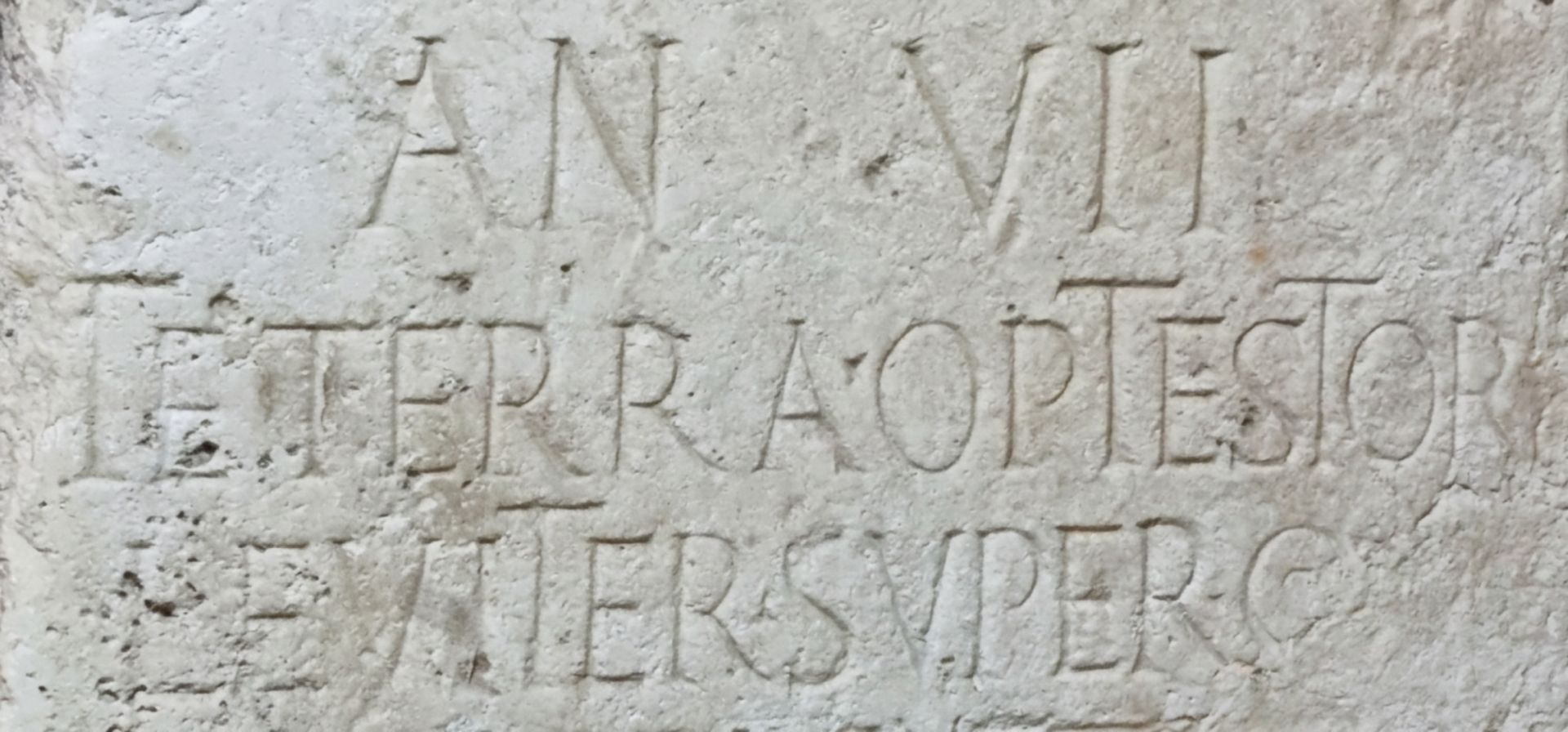
The international scholarly conference Funerary Epigraphy and Practices is being organised at the University of Zadar within the framework of the research project “Sit tibi terra levis: Formulae and Phrases from Funerary Monuments of Ancient Liburnia and Iapodia” (STTL). The project is led by Prof Anamarija Kurilić, PhD, from the Department of History at the University of Zadar, and is fully funded by the Croatian Science Foundation.
By studying funerary inscriptions – their content and their correlation with other relevant sources (archaeological, linguistic, historical, and others) – and by applying modern interdisciplinary methods, the project aims to deepen the understanding of Roman history and archaeology. It focuses primarily on the realm of funerary customs and rituals, and, through these, explores other aspects of daily life, social history, cultural practices, and the processes of acculturation and Romanisation among the populations of ancient Liburnia and Iapodia.
The results achieved thus far within the project, along with results of other similar researches, are being presented at this international scholarly conference, which brings together prominent Croatian and international researchers. Several participants will discuss the emotions expressed on tombstones from Roman Dalmatia: Olga Pelcer Vujačić (Podgorica) will present the formulas and phrases used to express emotions in the southeastern part of the province; Anamarija Kurilić (Zadar) will examine how spouses expressed their final farewells to one another; and Matteo Pola (Valtellina – Zadar) will explore how parents expressed the loss of their children. Amra Šačić Beća (Sarajevo) will discuss children and childhood, drawing on evidence from monuments found in the province’s interior. Anja Ragolič (Ljubljana) will present a demographic study on age at death, based on funerary inscriptions from the territory of the Iapodes.
Zrinka Serventi (Zadar) will address the depiction of a specific type of axe (ascia) and its symbolism on tombstones from ancient Liburnia, while Silvia Tantimonaco (Oviedo) will share observations regarding the terminology used to denote sarcophagi across the entire Adriatic region. Luka Donadini (Split) focuses on ethical reflections recorded on two monuments from Salona, the capital of the province. Several participants will present results obtained through the use of methods from the natural sciences – specifically, the application of a handheld 3D scanner for documenting Roman tombstones, as well as a comparison of data derived from LiDAR technology, RGB photogrammetry, and handheld 3D scanning in the documentation of cultural heritage (Ante Šiljeg, Fran Domazetović, and Ivan Marić, Zadar) – while Muamer Đidelija and Nedim Tuno (Sarajevo) will discuss the possibilities and limitations of using ground-penetrating radar (GPR) to identify buried archaeological and other features.